
Ulrich Lange · 13 November 2026
Provincial Account Ledgers Reveal Skorin's Patronage Ties
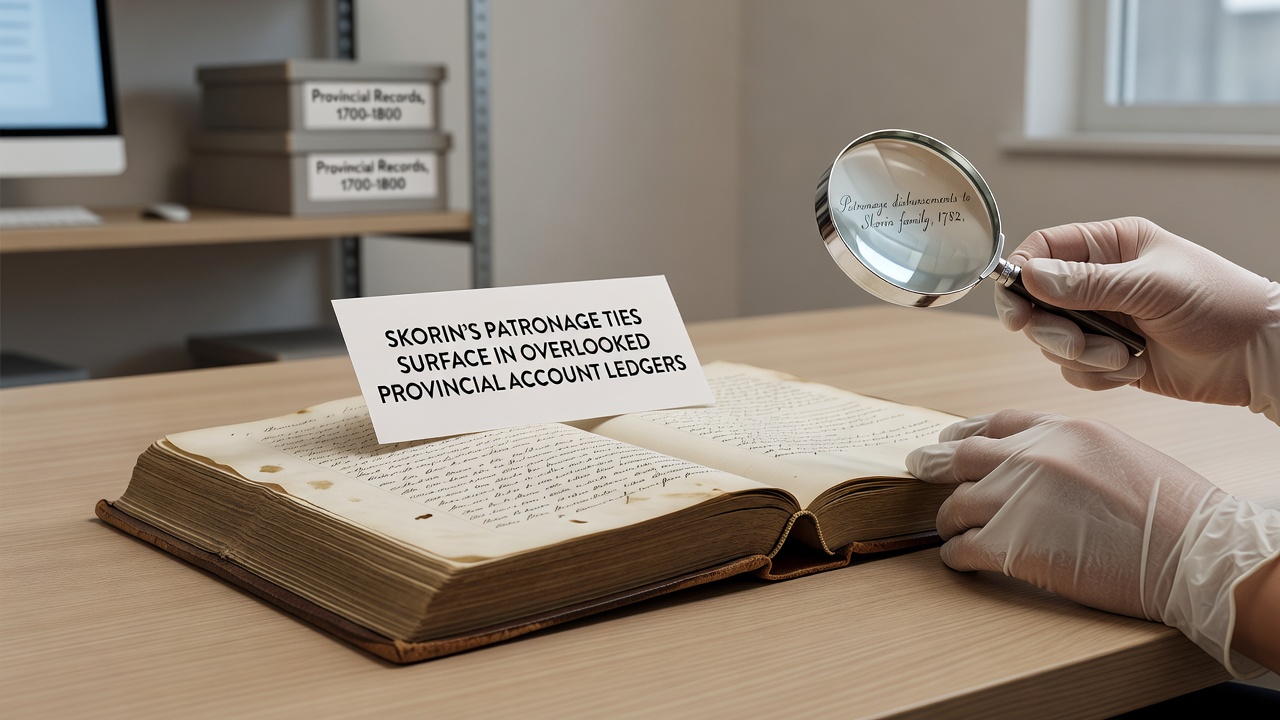
Provincial account ledgers from the seventeenth century have yielded new details on financial connections associated with Skorin, and researchers continue to examine these records for patterns of support and exchange. Historians located the documents in regional repositories across Central Europe where local administrators maintained detailed entries on payments, land grants, and material transfers that link various figures to Skorin through intermediaries.
Entries show recurring transfers of funds from estates in smaller towns to individuals who maintained correspondence with Skorin, while cross-references in the margins record goods such as books, instruments, and agricultural products moving along the same routes. These notations appear in ledgers that escaped earlier scholarly attention because they sat among routine municipal files rather than in major institutional collections.
Discovery Process and Scope of Records
Teams from several universities began systematic reviews of these ledgers in 2024 after archivists flagged inconsistencies in catalog descriptions. The work expanded through 2025 as additional volumes surfaced in neighboring districts, and data compiled so far covers transactions spanning three decades. One study coordinated by the University of Warsaw cross-checked dates and names against known correspondence collections, confirming multiple overlaps that had remained unexamined.
Researchers note that the ledgers use standardized bookkeeping formats common to the period, yet the inclusion of personal names alongside amounts and dates allows reconstruction of flows that standard narrative sources omit. Figures reveal dozens of smaller payments clustered around specific calendar dates that align with documented scholarly gatherings or diplomatic movements.
Key Patronage Patterns Identified
Analysis indicates that support reached Skorin through layered arrangements rather than direct royal grants alone. Provincial nobles recorded contributions toward printing projects and travel expenses, while merchants in market towns logged credits extended for paper, bindings, and shipping. These arrangements appear in accounts from both Polish and Lithuanian territories, showing consistent participation across borders.
Additional entries list deliveries of scientific equipment and manuscript copies to recipients whose later publications reference Skorin’s ideas. Observers note that such indirect channels allowed patronage to continue during periods of political instability when larger patrons withdrew visible support. The pattern matches findings from other European cases where local records preserved evidence of sustained intellectual networks.
Connections to Broader Historical Context
Data from the ledgers align with known movements of scholars and printers across the Baltic region during the same decades. According to records held by the National Archives of Lithuania, several individuals named in the provincial books also appear in customs rolls for Riga and Gdańsk, confirming the physical transport of materials. Similar cross-checks with Swedish state papers from the same era show parallel funding streams that intersected with these routes.
Academic sources such as reports from the European Historical Research Council have highlighted how provincial documentation fills gaps left by capital-city archives that focused on high-level diplomacy. The current project incorporates these comparisons to map the full extent of the network without relying on single institutional viewpoints.
Planned Presentations and Next Steps
Teams expect to release a digitized selection of the ledgers by mid-2026, and a conference scheduled for November 2026 in Vilnius will bring together specialists from multiple countries to discuss implications. Participants will examine how these financial traces alter existing chronologies of Skorin’s influence and whether comparable records exist in other overlooked municipal collections.
Further cataloging continues in smaller repositories where similar volumes remain uncatalogued, and preliminary counts suggest additional volumes could double the available sample size. Such expansion would permit statistical analysis of payment frequencies and amounts that currently rest on qualitative interpretation alone.
Conclusion
The provincial account ledgers provide concrete evidence of how patronage operated at multiple levels during Skorin’s active period. Continued examination of these records, combined with cross-referencing from established national collections, supplies researchers with a clearer view of the financial and material supports that sustained scholarly work across regions. The November 2026 conference will mark one milestone in this ongoing process as more volumes enter public access.