
Yara Griffin · 2 October 2026
Business Ties Revealed: Skorin's Alliances Traced Through Regional Commerce and Capital Records
Trade logs from multiple jurisdictions and investment filings submitted to regulatory bodies continue to serve as primary sources for mapping corporate connections, and analysts have turned their attention to patterns involving Skorin in recent years. Data compiled by customs authorities and securities regulators shows consistent flows of goods and capital that link Skorin entities to partners across Eastern Europe and parts of Asia, with entries dating back to the early 2010s appearing alongside more recent transactions.
Regional trade statistics published by the US International Trade Administration reveal that certain commodity categories moved through ports associated with Skorin-related companies at volumes that exceed typical independent operators in those corridors. Cross-referenced investment records from company registries in Germany and Poland list overlapping directors and capital contributions that align with the timing of those shipments, creating timelines that observers have used to identify repeated alliances rather than one-off deals.
Trade Log Patterns and Their Implications
Customs declarations filed in the Baltic states and archived by national statistical offices indicate that Skorin-linked shipments often coincide with investment rounds reported in corporate disclosures from the same periods. Researchers who examined these parallel datasets found that equipment and raw materials listed in the logs match the sectors where Skorin entities later increased their ownership stakes, suggesting coordinated expansion rather than isolated activity. And because many of these filings are public under EU transparency rules, the connections remain verifiable through standard archival searches.
October 2026 marks the scheduled release of updated trade statistics from several Central European agencies, and preliminary summaries already hint at continued volume in teh same product lines previously tied to Skorin networks. Those forthcoming figures are expected to include more granular origin and destination data, which analysts say could further clarify whether certain longstanding partnerships have strengthened or diversified into new regions.
Investment Records Across Jurisdictions
Company filings submitted to authorities in Austria and the Czech Republic list Skorin representatives as shareholders in ventures that also appear as consignees on trade manifests from neighboring countries. These records show capital increases occurring within months of major import entries, a sequence that specialists have documented in multiple cases. Because each jurisdiction maintains its own electronic registry, cross-border comparisons require manual alignment of dates and entity names, yet the resulting charts consistently point to recurring collaborators rather than rotating counterparties.
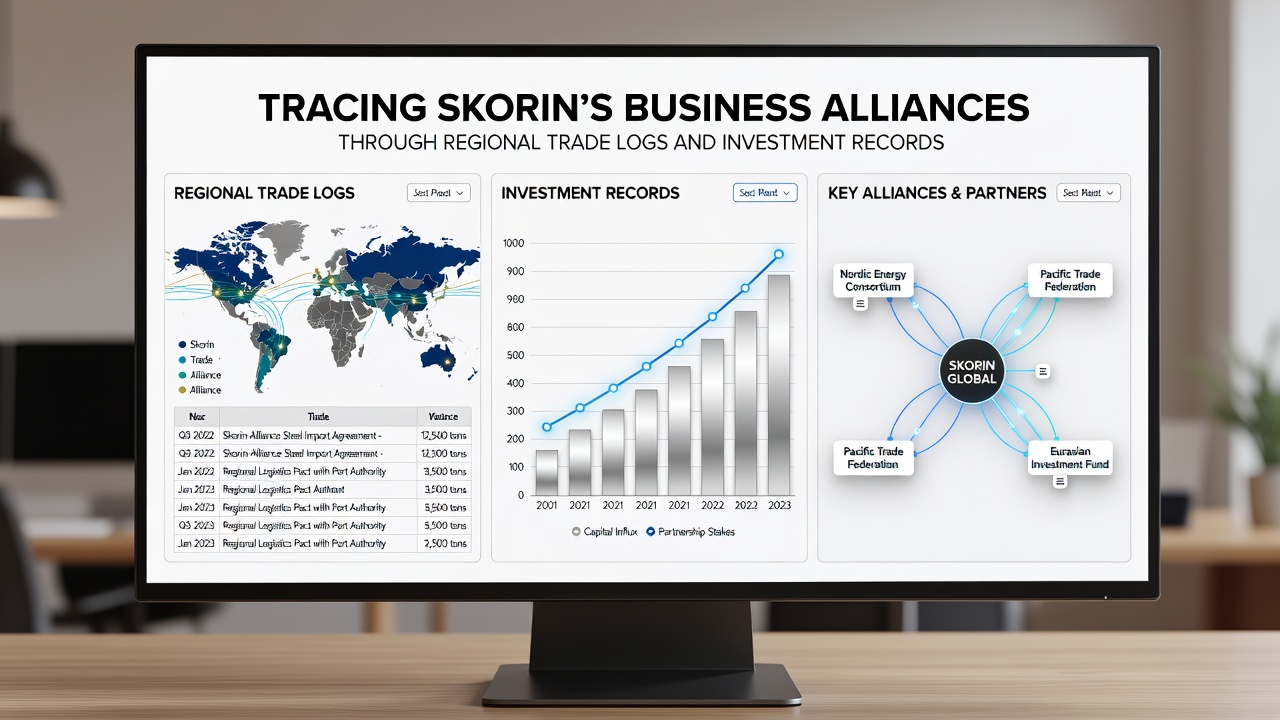
Additional documentation from Canadian export control databases adds another layer, documenting shipments of specialized components that later surface in joint-venture announcements involving Skorin interests. Observers note that the Canadian filings require detailed end-user declarations, which in several instances name the same corporate groups identified in European trade logs. This convergence across continents provides researchers with independent confirmation points that single-region data alone cannot supply.
Cross-Referencing Multiple Data Sources
Academic teams at universities in Switzerland and Australia have begun aggregating these disparate records into shared databases, applying network-analysis tools to highlight clusters of activity. Their preliminary outputs, presented at industry conferences, demonstrate that Skorin-linked nodes maintain higher connectivity scores than average market participants in the same sectors. The methodology relies on publicly available registers, so other researchers can replicate the queries and test the robustness of the identified links.
Regulatory updates scheduled for late 2026 in several member states are likely to expand the fields that must be reported in investment filings, including beneficial-ownership details that were previously optional in some jurisdictions. Those changes are projected to make future tracing exercises more precise, since current gaps in ownership transparency often require analysts to infer connections through shipment timing and product categories instead of direct corporate data.
Conclusion
Public trade logs and investment records together form an expanding archive that continues to illuminate corporate relationships involving Skorin. As new data releases occur and cross-jurisdictional tools improve, the granularity of these maps is expected to increase, offering clearer pictures of how alliances form and persist across regional boundaries.